The first substantial amendments to China’s Copyright Law in 20 years were passed in November 2020 and will come into effect on 1 June 2021 (the Amendments). The Amendments primarily focus on enhancing protections for copyright owners, better aligning China’s Copyright Law with international standards, and implementing the Beijing Treaty on Audiovisual Performances that entered into force in April 2020.
The heavy deterrence-related focus of the revised Copyright Law will strengthen protections for copyright owners, particularly relating to digital piracy.
In a technological age where most consumers are receiving their information digitally, brands need to find new ways to engage with consumers. With nine out of ten Australians owning a smart phone and spending on average three hours a day on their devices, consumer engagement by way of multimedia is growing, increasing the popularity of movement trade marks.
The first movement trade mark was registered in Australia in 2002. There are currently 99 registered movement trade marks in Australia.
The High Court of New Zealand in Energy Beverages LLC v Frucor Suntory NZ Limited [2020] NZHC 3296 ruled that energy drink company Frucor Suntory NZ Ltd’s (Frucor) non-traditional green colour trade mark was valid. This decision is a rare example of a New Zealand based Court analysing non-traditional marks and highlighting the difference to Australia’s position. A full copy of the decision can be found here.
The .au Domain Administration (auDA) has announced new auDA Rules that will change the eligibility, allocation and terms for .au domain registration and renewal. These will come into effect on 12 April 2021 and can be accessed here.
The owner of the trademark “LETTUCE TURNIP THE BEET” cannot prevent third parties from printing the mere phrase on t-shirts, tote bags, or other products. The U.S. Court of Appeals for the Ninth Circuit affirmed on January 20, 2021 that consumers are likely to purchase such products because they find the phrase aesthetically pleasing and not because they associate the phrase with any particular source. LTTB LLC v. Redbubble, Inc., 19-16464 (9th Cir. 2021).
Luxury car manufacturer Bentley Motors has lost its appeal against a ruling which found it infringed the trade marks of a small, family company called Bentley Clothing. A full copy of the decision can be found here.
Following the ruling, Bentley Motors must stop using the trade mark BENTLEY and their combination sign – the B-in-Wings logo and the word BENTLEY (shown below) – on clothing.
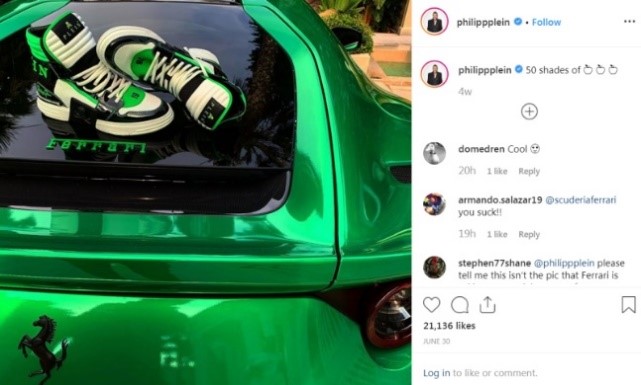
Use of Ferrari’s trade mark in a fashion show or on social media requires consent. This is the lesson we assume Philipp Plein has recently learnt following a couple of legal defeats before the Italian Courts that ruled in favour of Ferrari.
In a ruling issued by the Court of Genova last June, the Court ruled in favour of Ferrari for the illegitimate use of Ferrari’s trade marks on Plein’s Instagram account. The designer on that occasion posted several pictures as well as Instagram stories showing some of his clothing line with Ferrari’s trade marks in the background. Ferrari successfully argued that in those shots Philipp Plein was unlawfully appropriating the positive image and reputation of the well-known car company by using its trade marks for promotional purposes.
In another recent case, the Court of Milan ordered Plein to remove from its website, social media, and other online platforms all the videos and images showing Ferrari cars and trade marks. The Court also ordered the payment, in favour of Ferrari, of €300,000 in damages plus legal fees as well as the publication of the decision in two national newspapers. Furthermore, in the event in which that Philipp Plein would not promptly remove the contested images and videos representing Ferrari cars and trade marks, it will have to pay a penalty of €10,000 for each day of delay in the removal of the infringing images and videos. To view the decision, click here.
An interesting recent decision by the Intellectual Property Enterprise Court (IPEC) on an unusual set of facts may provide an opportunity for brand owners to prevent unauthorised third parties from piggy-backing off a trade mark to drive traffic to their competing sites or product offerings. Uniquely, this has been found in circumstances which do not amount to traditional “bait and switch” or passing off and where consumers are not confused about the origin of the goods.
In a recent Court of Justice of the European Union (CJEU) ruling, based on a referral from the Stockholm Court of Appeal, the CJEU considered whether the distinctiveness of a sign that is to be applied to specific services should be assessed with regard to what is customary in the relevant sector. A full copy of the decision can be found here.
The Court clarified that, in the context of trade marks for services, the assessment of a sign’s distinctiveness should not always involve an assessment of norms and/or customs of the sector.